
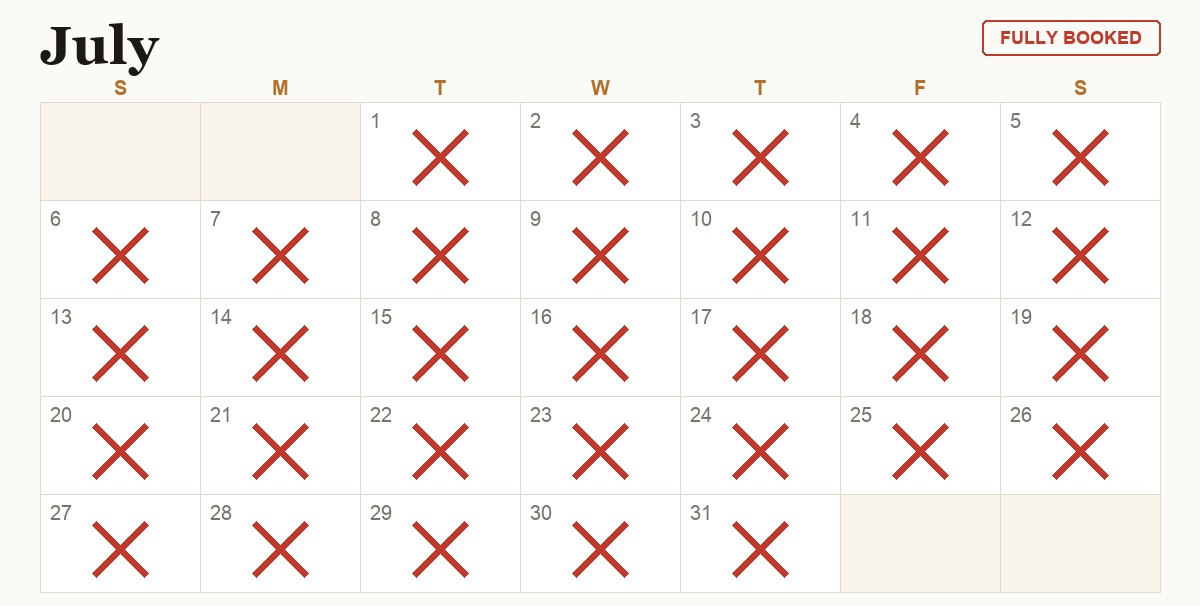
When Selling Out Costs You
The realtor who sold us our Wellfleet rental came to our housewarming party that first summer and asked, nervously, how the rental was performing.
We were ahead of our plan. We were also losing money.
Both were true, and neither was a problem. We’d gone in expecting to lose money for a couple of years while we figured out what the property could actually rent for. Success, I explained, was losing less next year than this already surprisingly less-than-expected year. She exhaled — she’d watched too many buyers walk into ownership assuming the rentals would make the cost of ownership disappear, then call her upset in October when the math didn’t work.
The math doesn’t work because many owners prioritize booking quickly over maximizing yield. The most common error is to set a number that doesn’t feel greedy, fill the calendar, and feel good about it.
You should not be happy selling out your first year easily. Or any year. If you fill the calendar early, you priced too low. That’s the whole post. The rest is figuring out what early means and what to do about it.
Filling up isn’t winning
You list at a price. The inquiries roll in. By January, May is locked. By March, the summer’s gone, and you pour yourself a drink.
Slow down. You didn’t nail the pricing. You nailed the fact that your house is desirable, at a price that was appealing. The early bookers — the ones who jumped — are the people looking for a great deal. They’re not the guests who pay top dollar in your market.
Top-dollar guests take their time. They know they have options, because that’s what having some cash teaches you. If your calendar was already gone when they were ready to book, you never met them. Your listing may have never turned up in their search.
Selling out early means you’re a great deal. It doesn’t mean you’re maximizing what you can earn.
What “early” actually means
Early is relative to your specific market. A beach house in a strong summer market: “early” is right around the holidays, when families plan next year over the kitchen table. A ski rental: during summer break. A lake property with a short season: April for July. An urban one-bedroom: a rolling thirty-day window where the test is occupancy rate, not calendar fill.
The simpler check is comparison. Pick three to five rentals in your market with similar size, location, and quality. Watch their calendars. If you go fully booked while they still have meaningful availability, your price is below theirs in a way the market is rewarding.
Remember too that comparisons are never exact and that very few features have a clear dollar value associated with them. Price comps are art. And personal to the buyer. You might get a lot more for your place than you’d pay to rent it. The only opinion on what a place is worth that matters is the market’s.
I’m not suggesting being mercenary. Owning a rental property is fun. But it’s a fun investment and I’m presuming that you want to make the most out of it without vibrating with anxiety.
What it costs
Run rough numbers. An owner with one decent-sized house grossing $40,000 a year over twelve weekly summer rentals, underpricing by $200 a week, leaves $2,400 on the table. Underpricing by $400 a week — which is what happens when you’ve stayed flat for a couple of seasons while everyone around you raised — leaves four to five thousand. That’s a new water heater. Or the property tax bill.
This is the part nobody talks about, because it doesn’t feel like loss. You’re cash-flow positive. The bookings come in. Nothing’s on fire. But the gap between what you’re charging and what the market would pay is real money, compounding quietly until the place down the road that’s not as nice as yours has out-earned you for three seasons running.
What to do next year
Raise. By how much depends on how clearly you underpriced.
A modest raise — two hundred a week — fits a stable market where you suspect you’ve drifted low. You’re testing where the ceiling is, not committing to a permanent number.
Three to five hundred a week is closer to right when your peak weeks filled earlier than last year, your comparables still have availability, and you raised by less than inflation. (Inflation has bounced between two and four percent recently; staying flat against that is already a real-dollar pay cut.)
When all of that is flashing at once and you haven’t raised in years, you are significantly under-priced. Raise in the high single digits or more. You’ll feel anxious doing it. Do it anyway. A slightly emptier January inbox shouldn’t scare you. The next five years of leaving the same $4,000 on the table you left this year — that should.
You might lose bookings at the margin. Losing the bottom of the inquiry pile is how you know you found the price. The day your inbox stops feeling effortless is the day you’ve found the market’s price point.
The thing pricing tools won’t tell you
A couple of years into ownership, another owner ran an AirDNA report on my house. I learned I was already over-performing their valuation by about 35% — more weeks filled, higher prices per week. And this was well before we’d actually found our ultimate price point.
Most dynamic-pricing software is built for property managers running fifty-plus listings, each paying a percentage to the manager. For an owner with one to three properties, those tools tend to optimize toward filling the calendar quickly — the exact failure mode this piece is about. That serves the property manager more than the owner.
The best pricing input for an owner-operator is a weekly habit. Pick five comparable houses. Watch them. Listen to your own inquiry velocity. Adjust. Your finger in the wind, calibrated against a real market, beats any algorithm that doesn’t know your house, your guests, or your reputation and that draws its data mainly from OTA’s that also have a commission-based interest in fill over yield.
A caveat
What I’ve described matches what I’ve watched in Wellfleet since 2019 and what I hear from owners I trust in ski and mountain markets. It doesn’t describe every property. A unique-stay yurt in a slow-growth region, a brand-new listing without a track record, a market scrambled by a regulatory change — the calibration might lead you somewhere wrong. The principles apply. The numbers are yours.
What’s the earliest you’ve been sold out, and what did you do the next year? Drop a note in the comments — the more owners share, the more useful these conversations get for everyone.